Category Archives: Article
Deconstructivism Building Style
Deconstructivism is a Postmodern architectural style characterised by the idea of fragmentation and the manipulation of a structure’s surface. Buildings adopting the style are often formed of components that have been disassembled and reassembled in a new and unorthodox way, giving the impression of a chaotic design devoid of precise logic.
It attempts to move away from the conventions of modernism that can be viewed as ‘constricting rules’, such as the notions that ‘form follows function’, ‘purity of form’, and ‘truth to materials’.
Exposed materials. The rise in prominence of computer-aided design (CAD) in contemporary architecture was a key factor in the development of deconstructivism, as three-dimensional modeling enabled the intricate design of complicated and unorthodox shapes and spaces.
Despite seeking to distance himself from the label, one of the most prominent architects associated with the style is Frank Gehry, whose Santa Monica residence – the building for which he first received critical acclaim – is regarded as the prototypical deconstructivist building, as well as his later buildings the Guggenheim Museum and Walt Disney Concert Hall.
Other architects who have been identified with the style are Zaha Hadid, Peter Eisenman, Rem Koolhaas, and Daniel Libeskind.
The most notable examples of deconstructivism are: CCTV Headquarters, Beijing. Dancing House, Prague. Imperial War Museum, Manchester. Guggenheim Museum, Bilbao. Jewish Museum, Berlin. Walt Disney Concert Hall, Los Angeles. F
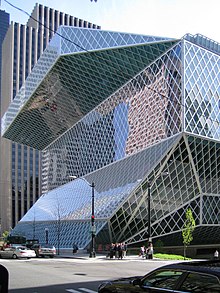
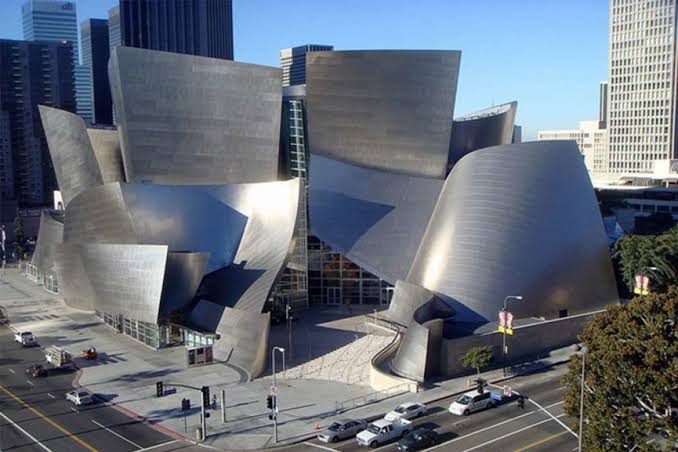
Deconstructive Building.
The new main central branch of the Seattle Public Library was designed by the Dutch architect Rem Koolhaas and opened in 2004. Deconstructivism, or Deconstruction, is an approach to building design that attempts to view architecture in bits and pieces. The basic elements of architecture are dismantled. Deconstructivist buildings may seem to have no visual logic. They may appear to be made up of unrelated, disharmonious abstract forms. Deconstructive ideas are borrowed from the French philosopher Jacques Derrida.
For examples of Deconstructivism in architecture, look at works by:
Peter Eisenman
Frank Gehry
Richard Meier
Rem Koolhaas
Exposed materials. The rise in prominence of computer-aided design (CAD) in contemporary architecture was a key factor in the development of deconstructivism, as three-dimensional modeling enabled the intricate design of complicated and unorthodox shapes and spaces.
Despite seeking to distance himself from the label, one of the most prominent architects associated with the style is Frank Gehry, whose Santa Monica residence – the building for which he first received critical acclaim – is regarded as the prototypical deconstructivist building, as well as his later buildings the Guggenheim Museum and Walt Disney Concert Hall.
Other architects who have been identified with the style are Zaha Hadid, Peter Eisenman, Rem Koolhaas, and Daniel Libeskind.
The most notable examples of deconstructivism are: CCTV Headquarters, Beijing. Dancing House, Prague. Imperial War Museum, Manchester. Guggenheim Museum, Bilbao. Jewish Museum, Berlin. Walt Disney Concert Hall, Los Angeles. F